Correcting the hydrostatic mass for non-thermal gas motions: a comparison of two approaches
Abstract
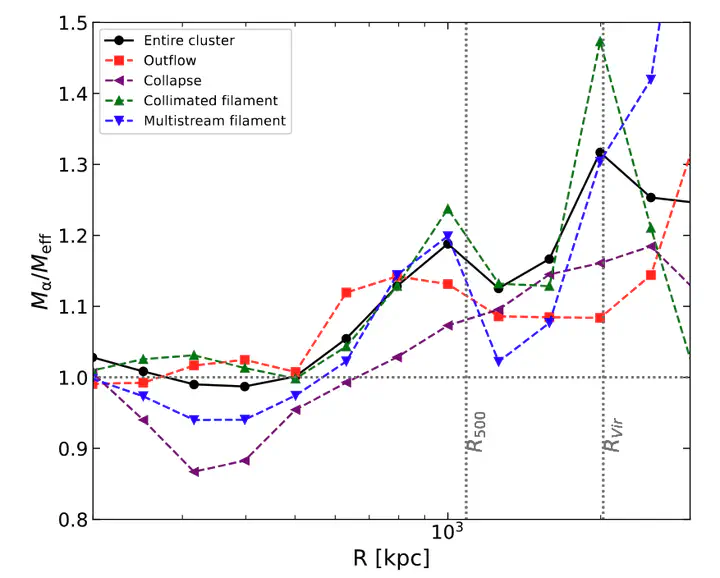
An accurate estimation of the mass of galaxy clusters is key to precisely and unbiasedly constraining cosmological parameters through their number count. The hydrostatic mass, estimated from the properties of the intracluster medium (ICM) assuming hydrostatic equilibrium, sphericity, and thermal-only pressure, is known to be biased by 10 to 20%, most likely due to non-thermal pressure support from gas motions. Two corrections have been proposed: i) replacing the thermal pressure by the total pressure Ptot=Pth+Pnth, or ii) adding effective mass terms derived from the gas momentum equation. We compare these approaches using a numerical replica of the Virgo cluster as a case study, estimating corrected masses from 3D radial profiles in different cluster regions and from projected sightline velocities mimicking XRISM observations. We find that the two methods do not yield the same results in 3D: the non-thermal pressure correction increases the mass by a growing amount with radius (from a few per cent in the core to ∼40% at the virial radius), whereas the effective mass terms provide a correction that varies less with radius. When estimated from projections, the two methods agree to within a few per cent for a given sightline, but the non-thermal pressure fraction is underestimated by about a factor of 2 compared to the 3D case. Furthermore, projection effects can change the inferred non-thermal pressure fraction by up to a factor of 2, particularly when the sightline is aligned with cosmic filaments.

Théo Lebeau
Postdoctoral researcher at the
I study the physics processes in the gas of in galaxy clusters and filaments using cosmological simulations.