Abstract
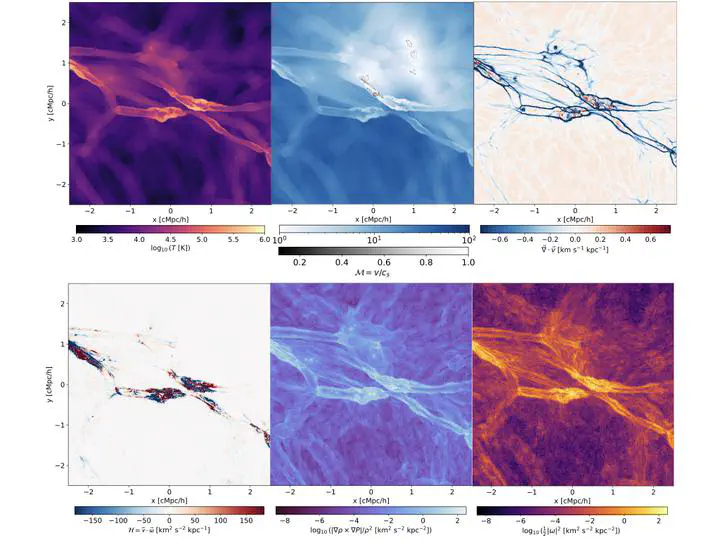
Much of the ordinary matter in the present-day Universe still escapes direct detection. These missing baryons are thought to reside in a warm-hot intergalactic medium (WHIM) threading the filaments of the cosmic web, whose turbulent and thermal state remains poorly constrained yet underpins any attempt to observe it. Beyond its observational stakes, how this turbulence emerges, as gravitational collapse converts the ordered inflow of the cosmic web into a disordered cascade, is a question of structure formation in its own right. In this work, we characterise the emergence of turbulence in the diffuse gas of a cosmic filament, following it from its assembly to the present day in the first simulation of the Web Evolution in Filament Targeted zoom simulations (WEFT) project. In this project, the cosmological zoom-in technique is used on a single cosmic filament, which is evolved from $z=63$ to $z=0$ with the moving-mesh code AREPO, reaching a median gas cell size of ~8 kpc within the filament. We trace the assembly of the filament and the thermodynamic state of its diffuse gas, the generation of vorticity at its accretion shocks through the kinetic helicity, enstrophy, and baroclinic term, and the growth of turbulent motions over cosmic time. We then quantify the intermittency of the cascade through high-order velocity structure functions and their relative scaling exponents from extended self-similarity. We show that the filament assembles by the hierarchical merging of several proto-filaments rather than by laminar accretion. We find that vorticity is seeded baroclinically where the rotating strands meet their accretion shocks obliquely. We show that the flow evolves from a supersonic, shock-dominated state, statistically close to the bifractal Burgers limit, into a developed, mildly supersonic, and intermittent cascade whose longitudinal exponents lie closest to the sheet-like She–Lévêque model at z=0. Turbulence is thus an intrinsic and quantifiable property of the diffuse gas of filaments, emerging through baroclinic vorticity generation and maturing into a developed, intermittent cascade. This pathfinder run provides the turbulent input on which forecasts of the observability of the WHIM can be based.
Théo Lebeau
Postdoctoral researcher at the
I study the physics processes in the gas of in galaxy clusters and filaments using cosmological simulations.